Minister Julian Popov: It is in Bulgaria's interest to have the European Emissions Trading Scheme
10 Mar, 2026 | 13:36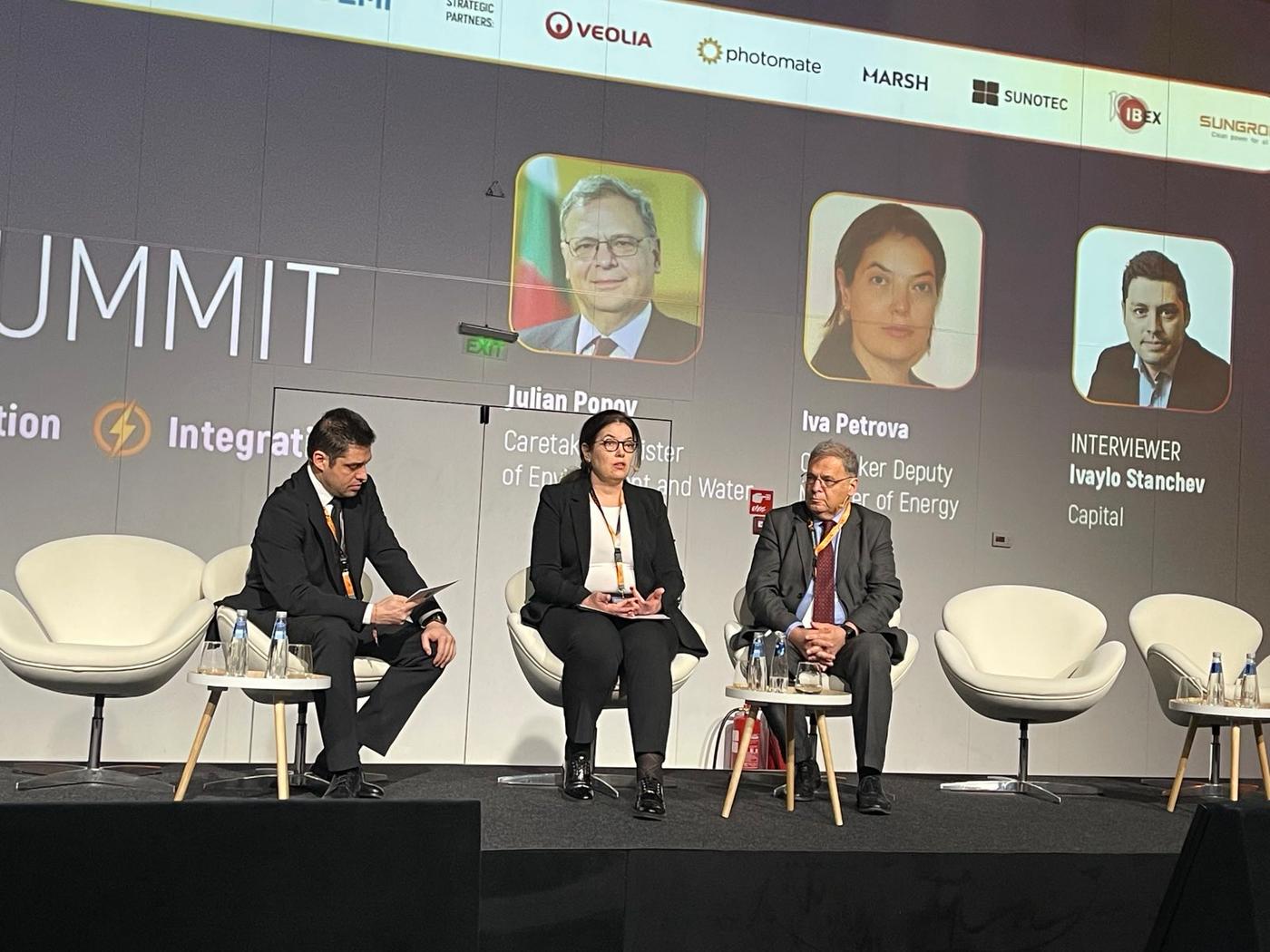
The European Emissions Trading Scheme (ETS) is a key instrument for modernizing the industry, reducing carbon emissions, and providing financial resources for investments in the green transition. This was stated by the Minister of Environment and Water Julian Popov during the Regional Energy Summit: Infrastructure, Innovation, Integration, organized by “Capital” in Sofia.
In response to a question, Minister Popov emphasized that Bulgaria is interested in participating in the ETS. The system not only stimulates emission reductions, but also provides significant revenues for Member States, which can be used for modernizing the industry and investing in clean technologies.
The Minister pointed out that Bulgaria can receive significant financial resources through ETS-2 and related European mechanisms, including through the Social Climate Fund. “If we try to block or weaken ETS-2, we risk depriving ourselves of about 3.5 billion Euros, which can be used for modernization and social support. For a country like Bulgaria, this is a serious resource,” emphasized Popov.
According to him, the key question is not whether the system should exist, but how to use its revenues so that they support the modernization of the industry and the economy. Minister Popov noted that the electrification of end-use consumption – the gradual replacement of fossil fuels in transport, heating, and the industry with electricity – is a key indicator for the modernization of the economy and the reduction of greenhouse gas emissions.
The European Union lags behind other major economies in this indicator, the minister specified. The share of electrification of end-use consumption in the EU is around 21–22%, while in China it reaches 32–33%. Bulgaria performs relatively well with around 27%, which creates good prerequisites for the development of the industry.
On the topic of renewable energy development, Minister Popov emphasized the potential of wind energy in Bulgaria. He pointed out that since 2012, investment proposals have been submitted for about 17-18 GW of wind power capacity, and the implementation of even a part of them would make a significant contribution to the country's energy system. According to him, there are misconceptions about the impact of wind energy on biodiversity. In many cases, it is possible to combine energy production and agricultural activity while complying with environmental requirements. "Wind energy is a long-term balancer in the energy system. There are investors and they are ready to invest without relying on public subsidies," emphasized the Minister and expressed his belief that it is extremely important for Bulgaria to develop this sector if willing to keep electricity prices low and preserve energy autonomy and energy independence.
“We have to be realistic - the coal industry is gradually disappearing. This is not a political decision, but an economic reality,” noted Minister Popov, reminding that in just a few years the share of coal energy dropped from about 40% to about 20%, and in the coming years it will probably drop even more, and after 2030 only 3-4% of annual production will remain. “This does not mean that coal-fired power plants should be closed immediately. In my opinion, they should remain as a strategic reserve - to be maintained and paid for their readiness, because there are wars and extreme situations in the world,” the minister pointed out.
Minister Yulian Popov also emphasized the role of the circular economy and the recycling of critical materials, including those contained in batteries and electronic devices. “We do not have many natural resources - we do not have enough gas, we do not have oil. But we have another advantage - the ability to recycle valuable materials,” he said. According to him, keeping these resources in Europe is important for resource security and for the development of the industry. He added that Bulgaria has good positions in this area and is among the leading countries in the European Union in organizing battery collection and recycling systems.
Deputy Minister of Energy Iva Petrova also participated in the opening panel of the Regional Energy Summit: Infrastructure, Innovation and Integration.