The Deposit System in Bulgaria: a Tool for the Transition to a Circular Economy
30 Apr, 2026 | 10:53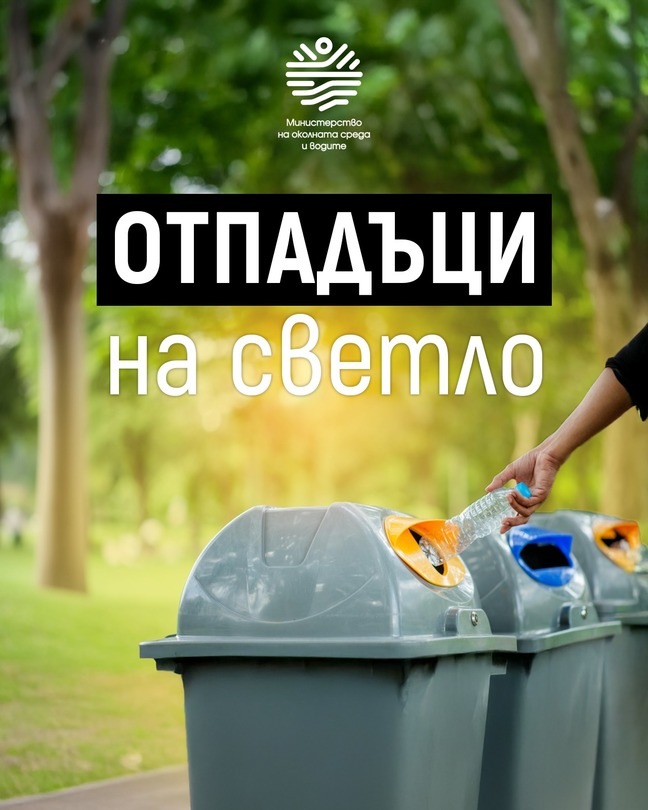
The Ministry of Environment and Water (MOEW) has published a new draft law related to the introduction of a deposit system for certain types of waste—a topic that has been on the agenda in Europe for years and is gradually becoming the standard for modern resource management. The news is important not only for institutions and businesses but also for every citizen, because it affects the way we consume, dispose of, and return valuable materials back into the economy. This is not just a new mechanism for collecting empty bottles and cans, but a strategic shift in how society views waste—not as unnecessary residue, but as a valuable resource that can be returned to the economy.
The topic is particularly important for the “Waste in the Spotlight” initiative because the deposit system effectively illuminates the entire journey of packaging - from the manufacturer and the store, through the consumer, to its recycling. This means greater transparency, higher collection rates, and more efficient management of the materials we use every day.
From a linear to a circular economy
For many years, the consumption model was relatively simple—produce, use, dispose. This approach is now economically and environmentally outdated. Limited natural resources, growing amounts of waste, and the need for a cleaner environment necessitate a transition to a circular economy - a system whereby materials remain in use for as long as possible.
This is precisely where the deposit system plays a key role. When a plastic bottle, glass bottle, or metal container has a recoverable value, it ceases to be waste. The consumer returns it, the system accepts it, the material is recycled, and it re-enters the production cycle.
This is a fundamental shift—waste becomes a raw material.
The European Context and Bulgaria’s Commitments
The new draft Law amending and supplementing the Waste Management Act is in line with European waste management policies and, more specifically, with Directive (EU) 2019/904 on single-use plastic products. The European Union sets clear targets for member states - high levels of separate collection of plastic beverage bottles and an increase in the share of recycled materials in new packaging.
For Bulgaria, this is not only a regulatory obligation but also an opportunity for modernization. The current model, based primarily on colored containers for separate collection, has yielded positive results but is reaching its natural limit. Some packaging does not enter the system, some becomes contaminated, and significant quantities remain outside the controlled stream.
The deposit system could be the missing link that leads to significantly better results.
The system is intended to cover the most widely used beverage packaging - plastic bottles, metal cans, and glass containers of certain sizes. Upon purchase, the consumer will pay a small deposit, which they will receive back upon returning the empty packaging to a designated collection point or reverse vending machine.
According to estimates from analyses, approximately 2 billion beverage containers are put on the market in Bulgaria each year. This demonstrates the actual scale of the system and its potential to return a significant volume of valuable materials back into the economy.
This mechanism has proven effective in a number of European countries. It creates a simple and understandable incentive - everyone returns the packaging because it has real value. In countries where deposit systems are already in place, collection rates exceed 90%, which significantly outperforms the results of traditional separate collection systems.
A central system operator to coordinate financial flows, logistics, reporting, and oversight will also be a key element. The participation of manufacturers and retailers in such a structure is an important prerequisite for sustainability, efficiency, and shared responsibility.
One of the most serious problems in waste management is the lack of traceability. Often, the public does not know how much packaging is placed on the market, how much is collected, and how much is actually recycled. The deposit system changes that. It allows for nearly complete tracking of the packaging flow - from its release onto the market to its return and recycling—which is difficult to achieve under current systems.
Through labeling, barcodes, and centralized reporting, the movement of packaging can be tracked almost in real time. This means greater transparency for the government, businesses, and citizens.
Another significant advantage is the quality of the collected materials. In mixed streams in containers, plastic and glass are often contaminated with household waste and food scraps. In the deposit system, packaging is collected separately and cleanly, which enables high-quality recycling, including the “bottle-to-bottle” model, in which old packaging is turned into new.
This reduces the need for primary raw materials and saves energy. This is particularly important in the context of rising raw material prices, as recycled materials are becoming an increasingly valuable resource for the industry.
Cleaner cities and less pressure on municipalities
A large portion of bulky waste in urban environments consists of beverage packaging. It can be found in parks, around bus stops, along roadsides, in open spaces between buildings, and in natural areas. When every bottle has value, the likelihood of it being discarded indiscriminately drops sharply.
This has a direct impact on municipal costs as well. Less waste in the overall stream means lower costs for collection, transportation, cleaning, and disposal. In the long term, this can also support more effective management of local household waste fees.
The deposit system is not just an environmental measure. It is also an economic tool. Its introduction creates a need for new logistics, reverse vending machines, sorting centers, digital management systems, and expanded recycling capacity.
This means investment, innovation, and new jobs. Furthermore, a steady flow of clean material provides certainty for the industry that uses recycled raw materials.
However, any major reform also requires thorough preparation. One key issue is how the system will function in small towns and how small retailers will be supported. A balance must be struck between environmental goals and administrative burdens.
Accessibility for citizens must be ensured so that returning packaging becomes an easy and natural part of daily life. Success depends not only on the law but also on the convenience of the system.
Public trust is just as important. People need to clearly understand how the mechanism works, why they pay a deposit, and how they get it back. A good communication campaign will be a key factor. Given that we are talking about over 100 000 tons of beverage packaging annually, the deposit system has the potential to bring about a significant change in waste management in the country.
Countries like Germany, Norway, Lithuania, Estonia, and others have already proven that deposit systems can achieve exceptionally high collection rates. In these countries, returning packaging is a normal habit, and the public environment is significantly cleaner.
Bulgaria has the opportunity to draw on this accumulated experience and build a system tailored to local conditions but based on the best European practices.
The Ministry of Environment and Water’s new draft law on the deposit system is one of the most significant steps toward modern waste management in Bulgaria in recent years. It demonstrates that our country can think strategically - not just in terms of how to dispose of waste, but how to turn it into a resource.
True success will depend on the partnership between the state, the business, municipalities, and citizens. If the system is designed in a smart, transparent, and accessible way, it will yield tangible results - cleaner cities, less pollution, more recycling, and a more responsible consumption culture.
“Waste in the Spotlight” means exactly that - making the invisible flows of waste visible, manageable, and beneficial to society. The deposit system is Bulgaria’s chance to take the next big step toward a true circular economy.